

#67 Harvard graduates play it safe. Derk Sauer didn't.
A Dutch journalist who made bold choices

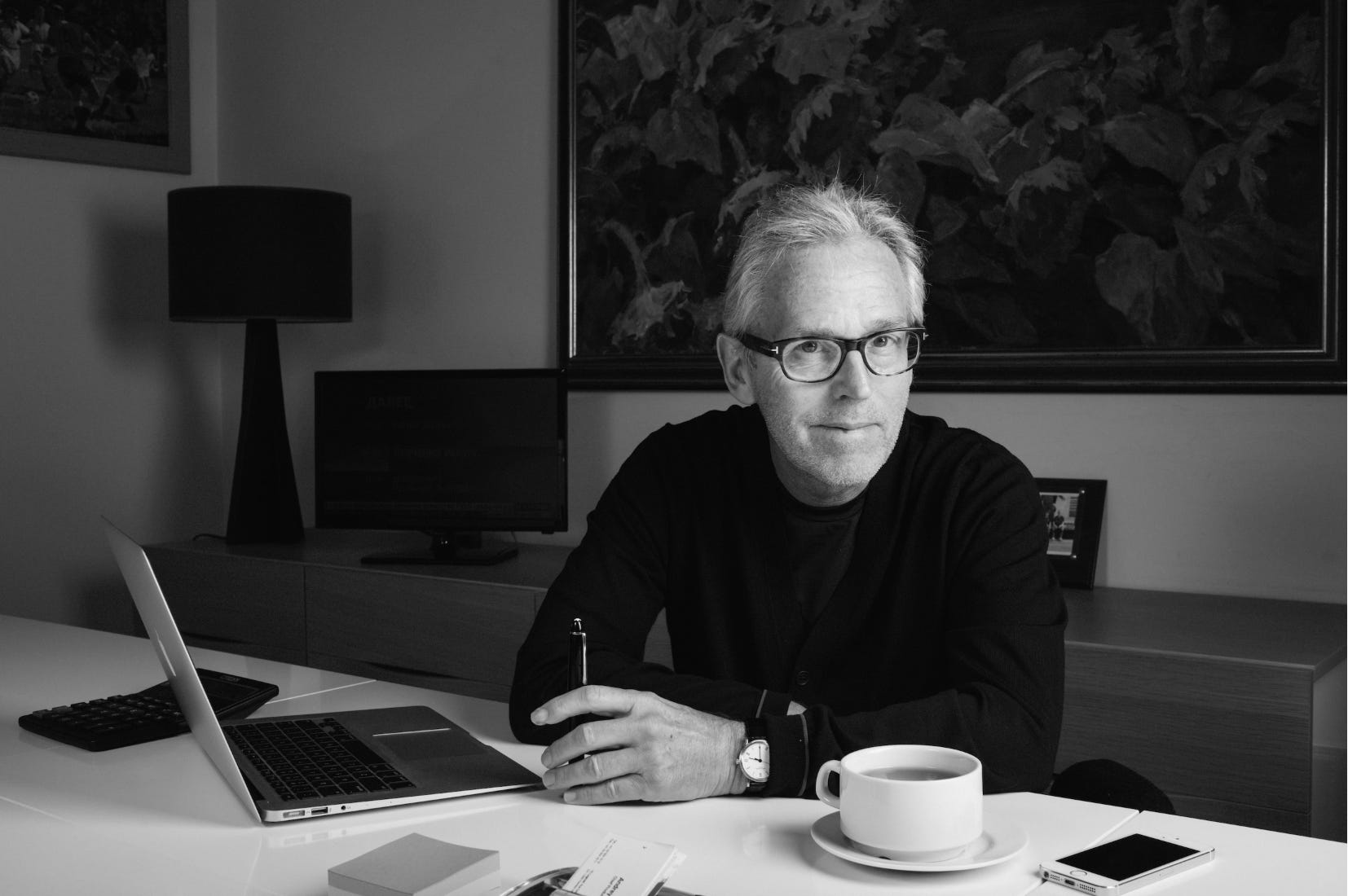
Derk Sauer © Semyon Katz
I am again about to start an edition with someone's death: Derk Sauer passed away last week at 72.
He was the Dutch journalist who built media empires in post-Soviet Russia and was one of the main contributors to building independent journalism in the country. Most notably, he convinced two major competing business outlets, the Financial Times and the Wall Street Journal, to launch a joint venture in Russia and create the Vedomosti newspaper. It became the leading business publication and established the journalistic standards for years. A good friend of mine was its editor-in-chief at some point.
The same day, I came across an article on Slate about Harvard students overwhelmingly choosing careers in consulting and finance upon graduation. The author argued that the real tragedy was that so many students do it by default. "When the most talented, resourced, and socially mobile students in the country are quietly surrendering their self-direction, it's not just a loss of imagination, but a failure of nerve."
Derk Sauer came from a wealthy family; his father was the head of a large pension fund. The contrast between two very different life choices of people from similar socio-economic backgrounds continued to haunt me.
I had the privilege of meeting Derk in person at the end of 2022 and spending an entire day with him at a work event. We had dinner together, and he impressed me with his humility, generosity, genuine interest in people, his sincere love for Russia, and a hint of romantic idealism that is so rare to maintain until such an advanced age.
I have been reading his obituaries, and have kept asking myself: what was his secret? How did he maintain the confidence that he could create value in any context? Value that would also be aligned with his sense of integrity?
The compound interest of courage
Sauer started early. While his brothers went to university and his twin sister to conservatory, teenage Derk was founding the Action Group for World Peace and distributing Marxist pamphlets at factory gates at 6 AM.
Harvard students, by contrast, have spent their formative years optimizing for approval. Every decision has been filtered through "Will this help me get in?" and then "Will this look good on my resume?" They've practiced compliance, not courage.
At 19, Derk Sauer packed a bag and flew to Belfast during The Troubles. "Hello, I'm Derk, can I help you?" he said to IRA commanders. He rented a room from one and helped smuggle weapons.
Meanwhile, Harvard students—arguably the most privileged young people in the world—queue up for McKinsey and Goldman Sachs. They've optimized their way through standardized tests, extracurriculars, and admissions. Why would they stop optimizing now?
The difference isn't talent, intelligence, or even opportunity. It's something more fundamental: Sauer had been practicing courage since he was 14.
The paradox of privilege
Some people believe that if they had a better socio-economic background, they would have more freedom in life.
Harvard isn't exactly known for its economic diversity — the average household income of a Harvard student is $168,000, and 67 percent come from the top 20 percent. Thanks to the university's generous financial aid program, nearly all students graduate debt-free, and yet they choose the narrowest life paths while having maximum optionality.
Sauer understood something that high achievers often miss: early career risks are asymmetric. At 19, flying to Belfast was financially cheap but experientially rich. The downside was limited; the upside was unlimited.
Harvard graduates face the opposite calculation—or think they do. They've invested so much in their credentials that any deviation feels like squandering their advantage. But this is precisely backwards. When you have Harvard on your resume, you have the ultimate safety net. You can afford to take risks because you can always fall back on conventional paths.
Unlimited potential as a burden
Here's where privilege becomes truly paradoxical: the more advantages you have, the more you feel responsible for not "wasting" them. Harvard graduates often speak about their "obligation" to maximize their potential—usually defined in terms their parents or society would recognize. Every choice feels like closing doors; every path not taken feels like a betrayal of their advantages.
But what if they have it backwards? What if the real waste is using your advantages to do exactly what everyone else does?
If you went to Harvard, you don't need to prove you can succeed at Goldman Sachs—of course you can. The question is whether you can succeed at something that matters to you, something that leverages your unique combination of interests, values, and circumstances.
When Sauer, in his early 40s at that point, moved his family to Russia in the 1990s to launch Moscow Magazine, friends thought he was crazy. "We weren't interested in luxury," he said. "We lived in a third-floor apartment. If you opened your refrigerator at night, cockroaches would crawl out."
He could afford this discomfort because he had something to fall back on. The Harvard students, ironically, act as if they have nothing to fall back on despite having everything.
It's not that Ivy Leaguers don't have dreams — it's that the system trains them to be scared of them.
Risk becomes less risky when you've survived enough risks to know you're resilient. Harvard students, having never truly risked anything, have no evidence of their own resilience. They're optimizing for a safety that their inexperience makes feel more necessary than it actually is.
The choice point
So how does this help us, confused readers of this newsletter, at our midlife point? It is a bit too late for us to get on a plane to help the IRA, and it has been a while since we were 19 years old.
The good news is that it's never too late to start practicing courage and making different choices. The bad news is that compound interest works slowly at first. A 22-year-old Harvard graduate choosing rebellion over Goldman might feel like they're falling behind their peers for years before the returns become visible. It is even more difficult for people who want to make a pivot after spending a couple of decades conforming to the norms.
But as Sauer proved repeatedly, courage is the only investment that pays dividends in every possible future. The returns on courage always exceed the returns on compliance. His media company Independent Media grew to become the market leader in Russia. In 2005, at 52 years old, he sold the company to the Finnish publisher Sanoma for €142 million. That same year he started a publishing house in the Netherlands and later invested in a TV channel.
In 2014, Sauer turned his attention back to Russia, where he had been asked by liberal oligarch Mikhail Prokhorov to head his media company, RBK. Due to his critical reporting, he quickly found himself under siege by Vladimir Putin. He was accused of fraud, police raids followed, and there were demands for him to be expelled from the country. In 2015, Sauer drew his conclusions: he resigned as director.
In March 2022, a few weeks after the Russian invasion of Ukraine, he moved to Amsterdam but didn't retreat into retirement. At 70, he provided critical support to major Russian media in exile and essentially saved a lot of journalists who otherwise would have been in prison.
He died on July 31st due to serious injuries incurred during a sailing accident a few weeks prior.
Derk Sauer chose to use privilege as a license to be unreasonable, to pursue what others called impossible, to risk everything for what he believed was important. Back in 2011, he said in an interview to De Morgen: "I'm still left-wing, and I vote left-wing. Luxury hasn't changed my worldview. I still think the world is extremely unfair, and that needs to change."
While some optimize careers, optimize for consequence
A friend recently told me: "You can have a stable job, a good income, and still be spiritually bankrupt. A life well-managed but unlived."
Derk Sauer made millions, yes — but that wasn't the point. Having met him in person, albeit briefly, I believe that he died knowing he had used every advantage he'd been given in service of something larger than himself.
His life story gave me huge inspiration for how to think about my own choices going forward. I felt like sharing it with you.
Until next time,
Nat
📚 To read:
The Well-Traveled Path: It feels like every Harvard student has the exact same dream. And it’s not just about the money. - an article by Zoe Lu, Slate
Journalist and entrepreneur Derk Sauer (1952-2025) was a courageous and happy man, with a great talent: he got things done - Derk’s obituary in Dutch, you need to set up a free account to be able to access it and use Google Translate to read it in your preferred language if you do not speak Dutch, Het Parool
Excellent papier, I like it, le courage est une qualité humaine qui fait défaut chaque jour dans des actes anodins et minuscules, ce n'est pas un privilège de la vie corporate, c'est autour de nous. Lorsque je fais le décompte de ces déceptions bien sûr, je remets dans la balance, car moi aussi il m'arrive de capituler, genre ni vu ni connu, mais ma seule excuse serait de m'en souvenir et d'en parler bien volontiers. Allez ... courage.